
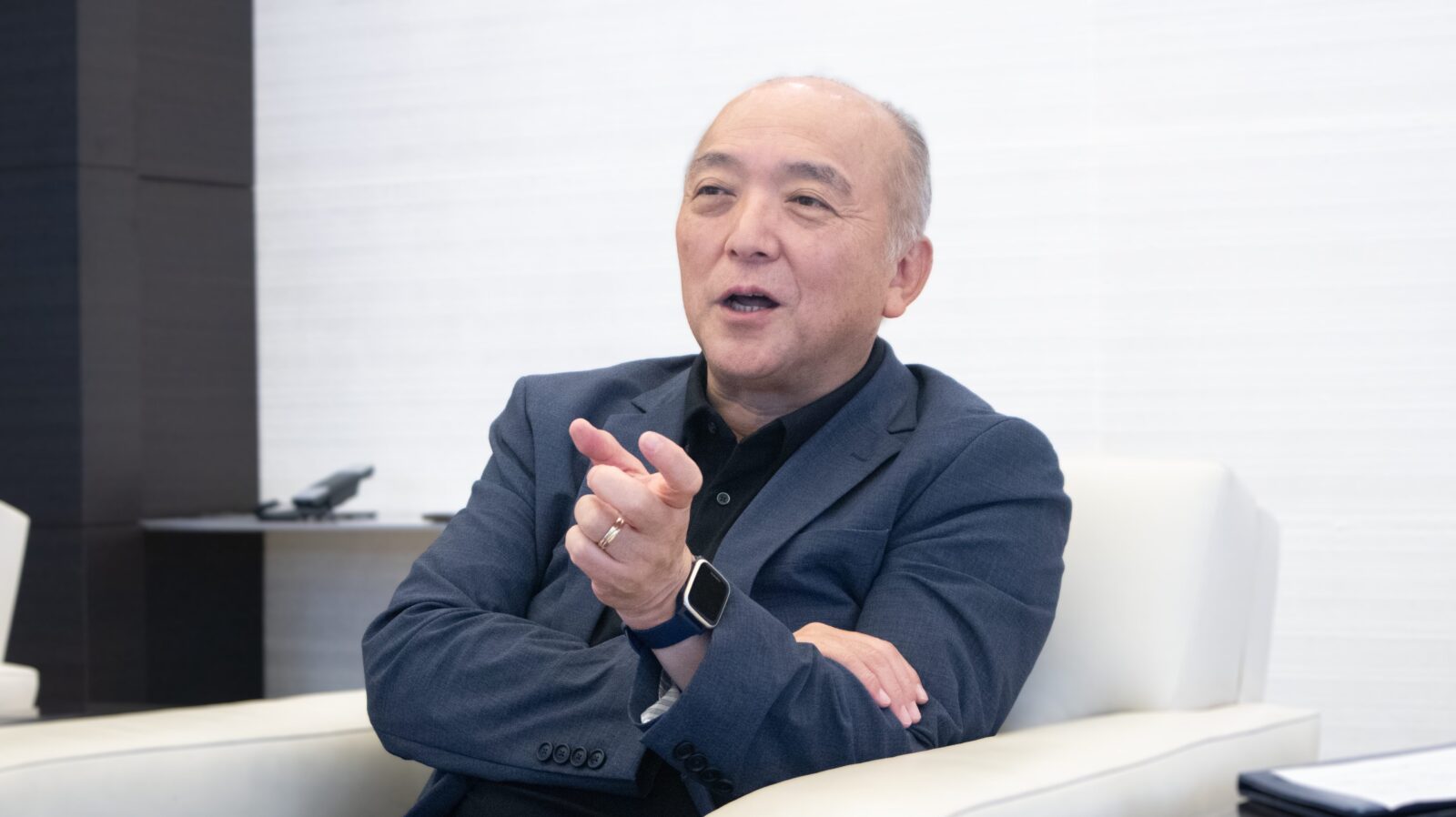
Akio Isowa, Group CDIO (Chief Digital Innovation Officer) of Sumitomo Mitsui Financial Group, has given shape to one unprecedented challenge after another from the heart of a megabank—one of Japan’s three largest banks.
Take Cotra and Bank Pay, which rewrote the conventions of money transfers and payments, or “SMBC Direct,” the forerunner of the personal integrated financial service “Olive”—a single app that brings together a bank account, credit card, payments, and investments.
What kind of person keeps taking on challenges that no one inside the organization will back—and keeps winning? Listen to him, and the answer turns out to lie not in the glamour of his achievements, but somewhere deeper: in how he sees the world, and in the values at his core.
- “At First, All I Did Was Look Backward”: A Career That Began with the Bubble’s Collapse
- Learning to Write Code Himself: Digital Reform from Last Place Among the Megabanks
- There Is Value in What No One Else Will Back
- Give Up ¥500 Million to Save ¥10 Billion
- A Desire to Better Society That Became Second Nature
- Banks Began as Money Changers — With Blockchain and AI, the Foundations of Finance Are Changing Again
- Making the Large Corporation a “Prism” for Society, to Transform Japan’s Industrial Structure
- “I Want to Work with People Who Refuse to Accept Path Dependence”
“At First, All I Did Was Look Backward”: A Career That Began with the Bubble’s Collapse
Isowa joined Sumitomo Bank (now Sumitomo Mitsui Banking Corporation) in 1990. Right afterward, Japan’s “bubble economy” — a late‑1980s asset bubble in real estate and stocks that suddenly collapsed — burst, and what awaited him at his posting was a mountain of bad debt.
For the next 15 years, the work he was assigned was not about moving forward, but about cleaning up the aftermath.
—— You’ve led so many reforms, Mr. Isowa. But what were the early days of your career actually like?
Isowa: You know, the moment I joined, the bubble burst, and there was nothing but bad debt. For 15 years I was in the general affairs department—the division handling crisis management, shareholder meetings, bad-debt processing. Not a single forward-looking job. Sumitomo Bank alone couldn’t survive, so in 2001 we merged with Sakura Bank, of the Mitsui group, to become Sumitomo Mitsui Banking Corporation. But even after the merger, it didn’t get any easier—just endless bad-debt processing. Then in 2003, we carried out the first capital reduction by a Japanese bank: drawing down capital we’d accumulated over more than a century. That year we did a capital reduction, a “reverse merger”—where a smaller subsidiary becomes the surviving entity and absorbs the parent—and held three shareholder meetings in a single year, right up to the annual general meeting. I thought I might die.
—— These were unprecedented, major undertakings right off the bat. When were you finally able to move on to forward-looking work?
Isowa: I finally moved to sales in 2008. I raised my hand and was sent to the corporate business office in Marunouchi—Tokyo’s central business district. And then, the very year I arrived, the 2008 global financial crisis hit.
—— A crisis the moment you joined, and a crisis the moment you moved to sales. What timing.
Isowa: Really (laughs). After that I was transferred to HR, and because I now knew the front lines, I proposed and carried out the first major overhaul of the sales structure since the merger, on my own initiative. I served a year as general manager of the Meguro corporate banking department, and from there it’s been 12 years in digital. Fifteen backward-looking years, a little sales in between, and now 12 years of digital. A fairly easy-to-follow career, isn’t it.
Learning to Write Code Himself: Digital Reform from Last Place Among the Megabanks
—— What state was the digital operation in when you were put in charge?
Isowa:We were lagging behind among Japan’s three megabanks—its largest banking groups. It started with retail—the app for individual customers of the bank. You’d open the smartphone app, and a browser would launch. It was an app, but the inside was just a browser display. So I said, fine, whatever it takes, let’s make it a real app. I told them: build 2,000 screens.
Isowa: At the time, there was no one in the company doing digital. Not even anyone who could write code. So I studied it myself. If you can’t write code, you can’t build an app, right? So I studied code myself, too, so that I could give concrete instructions for improving the app.
—— But surely you were still short of people.
Isowa: Short, yes. The IT strategy office handling the app had only seven people. How are you supposed to build an app like that? So I took those seven and made it 70 in a year. Sixty-three of them came from outside. There was no time to hire, so I brought people in on contract, or on secondment from other companies.
—— You gathered outsiders onto the bank’s floor.
Isowa: Yes. The people who came were the type who normally work in jeans. They’d say, “It’s a bank, so we need ties, right?” and I’d say, no, just as you are. I went and negotiated directly with the bank president: “Please allow my division alone to wear casual clothes.” People in jeans started working on the executive floor, and from the people around me I heard, “What on earth is he doing.” But it doesn’t matter. If you want them to come and do the work, that’s what it takes.
—— Did the reform show up in the numbers?
Isowa: Monthly active users of the app had been flat for 10 years, and just by improving the app, they grew from three million to four million. And here’s the interesting part: various departments started coming to me—”put our mortgage consultation desk on there too.” The first push is hard, but once it starts rolling, it grows on its own, like a snowball. The big company I’d assumed would never budge starts to become rather fun.
There Is Value in What No One Else Will Back
—— Looking back over your career, you’ve taken on a great many unprecedented challenges. In a large organization, why are you able to keep doing that?
Isowa: To begin with, at first I had no choice. Responding to the bad-debt problem brought on by the bubble’s collapse called for management decisions with no precedent—starting with the capital reduction. Carrying out a capital reduction required careful attention to a wide range of stakeholders and a great deal of procedure, and there was little precedent to follow. We had to feel our way forward, putting the systems and operations in order as we went, and it was enormously difficult. We faced one unprecedented situation after another—handling multiple shareholder meetings among them—but even so, the only way was forward. Looking back, the challenges of that time were less something I actively chose than the result of continuing to face the situation in front of me.
—— So the unprecedented challenges were, at first, a necessity. And yet, even if one has no choice, not many people can overcome it the way you did. In your later career, you seem to have taken on the unprecedented by your own choice.
Isowa: In a big company, you should assume that anything that can get approval won’t catch on. If everyone agrees with it, anyone can do it—so there’s no differentiation. That’s why I’m actually glad when people don’t buy in: it means it’s something only I can see. There are too many people for whom the means has become the end. Approval is supposed to be a means to achieve something. Yet getting the approval itself has become the goal.
—— Still, continually choosing the path no one will back can’t be easy.
Isowa: Of course it’s hard. When you’re told you won’t be backed, that you won’t be recognized, it’s a shock in the moment. There are times I think, “Oh, come on.” But then I can think, “Well, that’s fine.” Charging into something everyone agrees on is just chasing after others. If no one backs you, it means there’s something there that no one has seen yet—something only you can see.
Isowa: Once you change how you look at it, it’s not that painful. Even now, I’m seen as a bit of a maverick—an executive people watch with some wariness (laughs)—but isn’t that a good position to be in? Once you can see it that way, none of it is hard.
—— Were Olive and Trunk concrete examples of that—of what no one else would back?
Isowa: Yes. But those two, similar as they look, were built in completely different ways. Olive is a personal integrated financial service that brings together a credit card, a bank account, securities, and more. I kept saying “cashless is coming, let’s do it,” and even after I was transferred away, my team kept nurturing it. It’s an orthodox product, grown by the organization.
—— And Trunk?
Isowa: Trunk is a digital account service born from conversations with startups, where I realized just how poor the account-opening experience was. I started in 2019. Six years (laughs). And from the very beginning, I never once went to get approval.
—— That connects to what you said earlier.
Isowa: So I had the account-opening authority—which back then sat in the operations department—handed over to me: “give it to me.” When I figured I’d need a call center, I took that too. The components I’d eventually need for the service, I gathered little by little, without consulting anyone. The same innovative service can be grown by the organization, like Olive, or have its form built first by one person, like Trunk. Both are fine.
Give Up ¥500 Million to Save ¥10 Billion
—— When you push past opposition, you seem to have a consistent axis of judgment. Why are you able to stay so unshaken?
Isowa: When I was working on payments, I was pushing Cotra—a service that made transfers to other banks free—and got hammered in the management meeting. One executive said, “That transfer service brings in 500 million yen a year. Make it free and you’ll lose that 500 million.” Cannibalization, he called it. But here’s how I answered. As cashless payments spread, card usage grows, and there are plenty of other ways to make money. What we gain from the whole pie growing is far bigger than the 500 million we’d lose. More than that: handling cash alone costs us over 20 billion yen a year. If that halves, we cut 10 billion. Give up 500 million, save 10 billion—which would you take? That’s how I pushed it through.
—— Thinking in terms of the whole pie, not the immediate loss in front of you. Does that thinking carry over to your current work in the blockchain space?
Isowa: It’s exactly the same. There will always be people who fuss over losing a slice of existing revenue. But if the whole pie grows, that’s fine. Blockchain has the very same structure.
A Desire to Better Society That Became Second Nature
—— Pushing this hard, for this long, inside a large company seems almost irrational.
Isowa: Exactly—the most rational way to conduct yourself in a big company is to do nothing. Statistically, doing nothing gives you the best return on effort. The expected value is highest.
Isowa: But is that really okay? I think that’s what has led this country into decline. So I genuinely believe we have to change that very structure. That’s my greatest driving force. Even if I have to do it on my own, I want to make the world more convenient.
—— Where does that sense of “wanting to better society” come from?
Isowa: I wonder why, myself. Probably it has to do with how I was raised. In my family, not a single relative was a salaried employee. Maybe that’s why I have little interest in working hard just to watch my income inch up.
—— Is there anything else you’d point to as a root of that?
Isowa: In my student days I practiced kendo, and someone told me, “Train your spirit through kendo.” Perhaps that’s how I came to drift away from things like self-interest and a hunger for fame. Before I knew it, ”for society, for the world” had simply become second nature.
Together, these two things instilled in Isowa a single core: “not for myself, but for the world.” The capital reduction, the cashless push, Trunk—all of them are branches grown from that core.
Banks Began as Money Changers — With Blockchain and AI, the Foundations of Finance Are Changing Again
—— How do you view AI and on-chain finance?
Isowa: First, the big premise: a lot of people think a bank is a financier—that its job is to lend to customers. But originally that’s not it. The bank’s roots are in the money changer. In other words, an FX dealer.
—— An FX dealer?
Isowa: Edo-period Japan (1603–1868) was a country where two currencies circulated at once. The gold coins minted in Edo were like crypto assets with nothing backing them. The silver coins, backed by rice as a store of value, were like a stablecoin. The money changers adjusted the exchange rate between the two, and in doing so regulated the domestic economy itself, which was otherwise tossed about by good and bad rice harvests. A well-designed country, isn’t it—it was as if crypto assets and stablecoins circulated domestically.
Isowa: Then, because we could no longer raise funds from abroad during wartime, banks were made to gather up the nation’s deposits and channel them into military spending and large corporations. The bank’s present form is merely one shape it was given later, out of national circumstance. Policy has shifted what the core business is. And now, with blockchain and AI, the time has come for it to shift dramatically once again.
—— Which technology do you feel the strongest sense of promise about?
Isowa: AI and programmability fit extraordinarily well with finance. Finance is, after all, a world of numbers and rules. So almost everything we used to do by hand will be replaced, just as it is, by AI. I think more than 90% of our internal operations will become that way. If so, you’re better off doing it without fear. And it’s not only internal work—building AI into customer-facing products, too, will become a matter of course.
—— What changes when things go on-chain?
Isowa: The very “surface area” of banking expands dramatically. Right now we’re a bank operating within Japan, because there are walls—borders and regulations. But as we move closer to on-chain, those walls can be crossed. Work that’s now confined to Japan might become something you can do just as normally in Africa or South America. The field of business itself widens all at once.
—— Within the company, though, isn’t this still a hard idea to get across?
Isowa: It’s exactly like the cashless era. Back then, too, there was a plausible-sounding line: “Japan is safe, there’s no counterfeit currency, ATMs are this widespread—so it won’t go cashless.” But in barely 10 years, the bills vanished from our wallets. Today’s common sense changes completely in 10 years. Blockchain is exactly the same.
Making the Large Corporation a “Prism” for Society, to Transform Japan’s Industrial Structure
—— That way of “thinking in terms of the whole pie” seems consistent with your current work too. What are you focusing on most right now?
Isowa: I’m creating a new role called “Innovation Catalyst.” Across Asia, Japan, and New York, there are now about 2,000 startups whose substance I understand well. I want to connect those 2,000 with large and mid-sized corporations. Through that, I want to change Japan’s industrial structure.
—— Is that different from an exit via M&A?
Isowa: It’s different. If you acquire a startup and pull it toward the large company—with its high path dependence, the organizational tendency to keep doing things the way they’ve always been done—what’s the point? I think the startup’s strengths would be lost. I want to do the reverse: bring the large company’s technology toward the startup.
Isowa: For example, if you pour serious capital into a startup and consolidate the patents lying dormant inside large companies—technology that goes unused because the ROI (return on investment) doesn’t add up—a new pie might be born. Rather than fighting over a limited share in a shrinking country, you make the whole pie bigger. It’s the same thinking as with Cotra.
—— Why do you insist on the position of the large corporation?
Isowa: If you’re going to work at a big company anyway, it’s more interesting not to be used by it, but to use it like a prism to project influence onto the world. Rather than becoming the big company’s tool, make the big company your tool—isn’t that more fun?
Isowa: If I, one individual, shout “cashless,” no one turns to look. But when an organization with an enormous nameplate moves, the very current of the world changes. This is a kind of credit creation. A large company’s credibility is an asset that can be used to move society.
“I Want to Work with People Who Refuse to Accept Path Dependence”
—— What kind of people do you think will thrive in the era ahead? What kind of people do you want to work with?
Isowa: People who refuse to accept path dependence. Once you’re inside a big company, it’s comfortable. You do only what you’re told, you go home when the clock says so, the benefits and social insurance are all in place. There’s nothing as cozy.
Isowa: I might be fine. But if everyone does that, society gradually shrinks. People who can think, “that’s not good enough”—who consider not just the company but society—those are the people I want to work with.
—— And that’s not limited to people who’ve always been inside large companies.
Isowa: In the past, only people who’d spent their whole careers inside a big company could use it. But now, someone who comes in midway, from the outside, can move to the side that uses the big company. Startups leverage large companies to change Japan. In a mature country like ours, I believe that’s the only way.
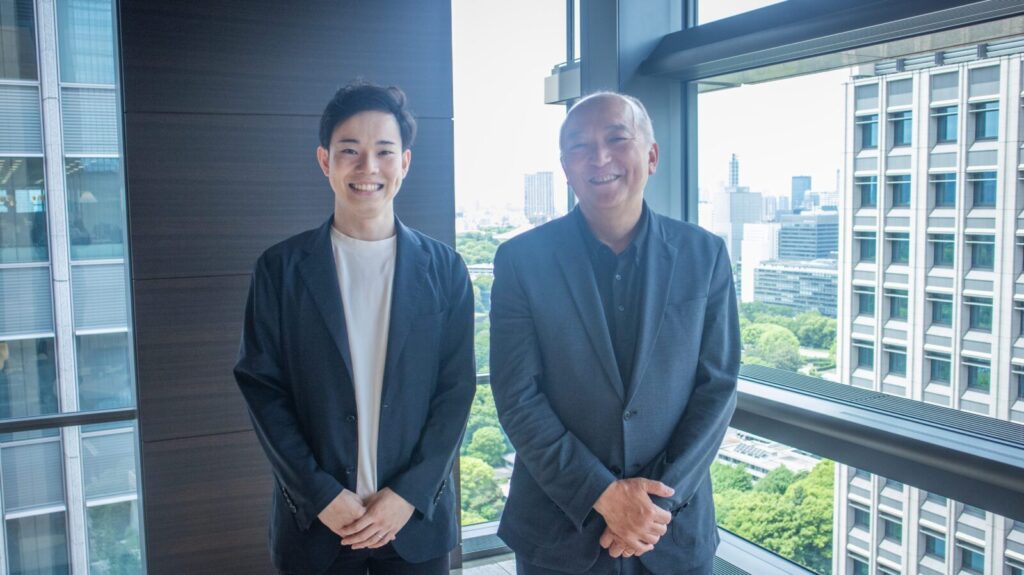
There is opportunity in what no one else will back. There is value precisely because no one else does it. At first glance, it may look like a losing way to live inside a large organization. But it is precisely because Akio Isowa has held to that stance for more than 30 years that he remains an innovator who continues to lead the industry.
Behind it all was nothing more than a pure wish, unchanged since childhood: to make the world a better place.